

Prostrations
A study in humility, repentance, and offering prayer with both body and soul.
"Prayer is not only spoken by the lips but offered by the whole person."
— DOXA & STAVROS
✠
The Study
From the earliest centuries of Christianity, believers have prayed not only with words but with their entire body. Standing, bowing, kneeling, and making prostrations are outward expressions of an inward humility before God.
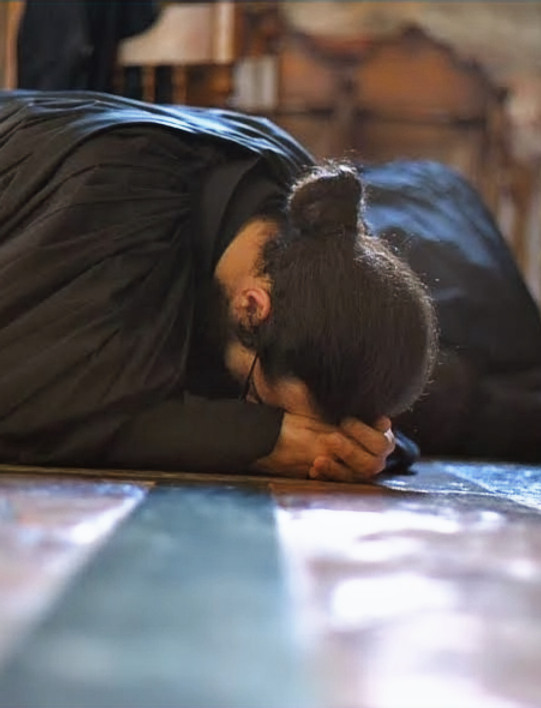
A prostration is far more than a physical movement. It is a visible confession that God alone is Lord and that we come before Him with repentance, gratitude, and love. In Orthodox worship, the body is never separated from the soul. Just as the lips speak prayer, the body also participates in prayer.
Every movement reminds us that we were formed from the earth, yet are continually being raised by the mercy of Christ.
✠
The Ancient Christian Practice
One common misunderstanding is that prostrations are borrowed from Islam because many people first encounter them in that context. In reality, Christians were making prostrations centuries before the rise of Islam in the seventh century.
From the earliest days of the Church, Christians inherited bodily expressions of prayer from both the Old and New Testaments. Throughout Scripture, the faithful are described as falling before God in worship, repentance, thanksgiving, and supplication.
The early Christians continued this tradition, and the practice has remained part of Orthodox worship ever since.
Orthodox prostrations are therefore not a later adoption but a continuation of one of Christianity's oldest forms of prayer, a tradition preserved in the life of the Church for nearly two thousand years.
✠
Prostrations and the Jesus Prayer
Many Orthodox Christians make prostrations while praying the Jesus Prayer:
"Lord Jesus Christ, Son of God, have mercy on me."
A common practice is to make the sign of the Cross, offer a full prostration, rise again, and repeat the prayer. This rhythm may continue for as many repetitions as one's Prayer Rule prescribes.
The number of prostrations is not determined by personal preference but is ordinarily established with the guidance of one's priest or spiritual father. Some prayer rules may include only a few prostrations, while others may prescribe many. The goal is never to complete a certain number but to pray attentively, with humility and repentance.
As with every aspect of Orthodox prayer, the outward movement serves the inward life. The body bows before God while the heart continually calls upon the mercy of Christ.
✠
What Is a Prostration?
A full prostration consists of making the sign of the Cross, bowing to the ground until the forehead touches the floor, and then rising again.
Orthodox Christians also practice smaller bows, often called metanoias, in which the body bows from the waist without going completely to the floor. Both are expressions of reverence and repentance.
Whether making a full prostration or a bow, the purpose is not the movement itself but the prayer that accompanies it.
✠
Why Orthodox Christians Make Prostrations
Throughout Holy Scripture, God's people frequently fell to the ground in prayer before Him.
Prostrations express several realities of the Christian life:
-
Humility before God
-
Repentance for sin
-
Reverence during prayer
-
Thanksgiving for His mercy
-
Complete dependence upon Christ
Each prostration becomes a silent confession that every good thing comes from God alone.
The body bows low, yet the soul is lifted toward Heaven.
✠
Guided by the Church
One of the defining characteristics of a Prayer Rule is that it is not ordinarily created in isolation.
Orthodox Christians are encouraged to establish their Prayer Rule with the guidance of their priest or spiritual father.
Every person lives under different circumstances.
A young parent.
A student.
A monastic.
Someone who is elderly or ill.
Someone newly received into the Church.
Because every soul is different, the Church wisely recognizes that every Prayer Rule may also be different.
The purpose is never comparison.
It is faithfulness.
Obedience protects us from placing unnecessary burdens upon ourselves or adopting practices beyond our present strength. A prayer rule received with humility often bears greater fruit than one created from personal ambition alone.
✠
Prostrations Within a Prayer Rule
Many Orthodox Christians include prostrations as part of their daily Prayer Rule.
Often they accompany:
-
The Jesus Prayer
-
Morning or Evening Prayers
-
Intercessions for family and friends
-
Prayers for the departed
-
Times of repentance and fasting
The number of prostrations is not chosen simply by personal preference. Rather, it is ordinarily established with the guidance of one's priest or spiritual father, who considers a person's health, responsibilities, spiritual maturity, and individual circumstances.
For one Christian, the rule may include several prostrations. For another, only a few. Some may perform waist bows instead of full prostrations because of age or physical limitations.
The goal is never to accomplish an impressive number, but to cultivate faithful prayer offered with humility.
✠
The Heart Matters Most
It is possible to perform countless prostrations while the heart remains distracted.
It is also possible for someone unable to kneel because of illness or age to offer a prayer that is deeply pleasing to God.
The outward act serves the inward life.
The purpose of every prostration is not simply to lower the body but to humble the heart.
✠
Seasons of the Church
Prostrations become especially prominent during periods of repentance, particularly Great Lent.
At other times, such as the joyful season from Holy Pascha through Pentecost, the Church's worship changes to reflect the Resurrection, and certain forms of kneeling or prostrations are omitted during the Divine Services.
These practices remind us that Orthodox worship follows the rhythm of the Church's liturgical life rather than individual preference.
✠
Frequently Asked Questions
Must every Orthodox Christian make full prostrations?
No. Physical limitations, age, illness, or injury may prevent someone from making full prostrations. Waist bows or standing reverently in prayer are often appropriate alternatives.
When are prostrations usually made?
Many Orthodox Christians make them during their daily Prayer Rule, while praying the Jesus Prayer, during Great Lent, and at other appointed times within the Church's liturgical life.
How many prostrations should I make?
There is no universal number. A Prayer Rule, including prostrations, is ordinarily established with the guidance of one's priest or spiritual father.
✠
Closing Reflection
Every prostration is a quiet reminder that the Christian life begins with humility.
We lower ourselves before God not because He delights in our weakness, but because He alone has the power to raise us again.
In bowing before Christ, we learn that true strength is found not in lifting ourselves up, but in entrusting ourselves completely to Him.
✠
Continue Your Study
Explore the Gallery
From the Curator
A curated collection of studies preserving Orthodox tradition, sacred craftsmanship, and the timeless beauty of Christian heritage.